
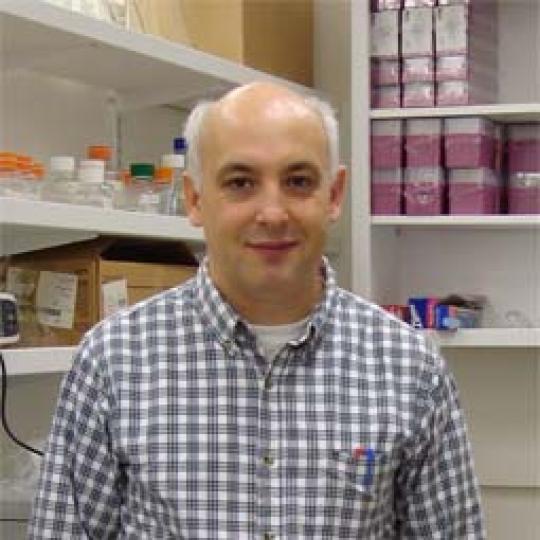
Farid Kadyrov, PhD
About me
Farid Kadyrov received his PhD in Biochemistry in 1997 from the Institute of Biochemistry and Physiology of Microorganisms of the Russian Academy of Sciences at Pushchino. After completing postdoctoral trainings with Jan Drake at NIEHS and Paul Modrich at Duke University, he joined the SIUC faculty in 2008.
Research interests
The mismatch system is a major DNA repair system that protects humans from both sporadic and inherited cancers. The primary function of the mismatch repair system is the correction of DNA replication errors. It also removes DNA mismatches formed during strand exchange in homologous recombination, suppresses homeologous recombination, participates in the DNA damage response, and plays an important role in expansion of certain triplet repeats. Inactivation of the mismatch repair system increases the spontaneous mutation rate ~100 fold and strongly predisposes humans to both inherited and sporadic cancers. Loss-of-function mutations in the MLH1, PMS2, MSH2, and MSH6 genes of the mismatch repair system are the molecular basis of two cancer predisposition syndromes: Lynch syndrome and Turcot syndrome. Furthermore, it is known that methylation of the MLH1 promoter causes about 15% of sporadic cancers in a number of different human tissues.
Current evidence indicates that the primary mismatch recognition factor MutSα (MSH2-MSH6 heterodimer), MutLα endonuclease (MLH1-PMS2 heterodimer), the replicative clamp PCNA, the clamp loader RFC, the 5'-3' exonuclease EXO1, the secondary mismatch recognition factor MutSβ (MSH2-MSH3 heterodimer), and DNA polymerase δ (Pol δ) are required for human DNA mismatch repair. Several human DNA mismatch repair reactions have been reconstituted with purified proteins and defined DNA substrates. The key human DNA mismatch repair reaction that has been reconstituted depends on the activities of the primary mismatch recognition factor MutSα, MutLα endonuclease, the PCNA clamp, the clamp loader RFC, EXO1, the ssDNA-binding protein RPA, and Pol δ. This DNA mismatch repair reaction is initiated as a result of mismatch recognition by MutSα. After recognizing the mismatch, MutSα cooperates with loaded PCNA to activate MutLα endonuclease. The activated MutLα endonuclease incises the discontinuous daughter strand 5' and 3' to the mismatch. An incision produced by MutLα 5' to the mismatch is utilized by MutSα-activated EXO1 to enter the DNA and remove the mismatch in a 5'-3' excision reaction modulated by RPA. The generated gap is repaired by DNA polymerase δ holoenzyme (Pol δ HE).
Expansion of triplet repeats causes a number of neurodegenerative diseases. Triplet repeats are expanded through replication-dependent and replication-independent mechanisms. Recent studies revealed that MutSβ, MutLα endonuclease, and MutLγ endonuclease are involved in triplet repeat expansion.
Gender
Academic Location
Academic Office
Contact Info
Publications
Selected Publications
Kumari, D., Grant-Bier, J., Kadyrov, F., Usdin, K. (2024). Intersection of the fragile X-related disorders and the DNA damage response. DNA Repair. 144:103785.
Kadyrova, L.Y., Mieczkowski, P.A., Kadyrov, F.A. (2024). MutLα suppresses error-prone DNA mismatch repair and preferentially protects noncoding DNA from mutations. J. Biol. Chem. 300(6):107406.
Kadyrova, L.Y., Mieczkowski, P.A., Kadyrov FA. (2023). Genome-wide contributions of the MutSα- and MutSβ-dependent DNA mismatch repair pathways to the maintenance of genetic stability in Saccharomyces cerevisiae. J. Biol. Chem. 299(5):104705.
Lin, Y.C., Liu, D., Chakraborty, A., Kadyrova, L.Y., Song, Y.J., Hao, Q., Mitra, J., Hsu, R.Y.C., Arif, M.K., Adusumilli, S., Liao, T.W., Ha, T., Kadyrov, F.A., Prasanth, K.V., Prasanth, S.G. (2022). Orc6 is a component of the replication fork and enables efficient mismatch repair. Proc. Natl. Acad. Sci. U S A. 119(22): e2121406119.
Kadyrova, L.Y., Dahal, B.K., Gujar, V., Daley, J., Sung, P., Kadyrov, F.A. (2022). The nuclease activity of DNA2 promotes Exonuclease 1-independent mismatch repair. J. Biol. Chem. 298(4):101831.
Kadyrova, L.Y., Gujar, V., Burdett, V., Modrich, P.L., Kadyrov, F.A. (2020). Human MutL, the MLH1-MLH3 heterodimer, is an endonuclease that promotes DNA expansion. Proc. Natl. Acad. U.S.A.117 (7):3535-3542.
Mazina, O.M., Somarowthu, S., Kadyrova, L.Y., Baranovskiy, A.G., Tahirov, T.H., Kadyrov, F.A., Mazin A. V. (2020). Replication protein A binds RNA and promotes R-loop formation. J. Biol. Chem. 295(41):14203-14213.
Dahal, B.K., Kadyrova, L.Y., Delfino, K.R., Rogozin, I.B., Gujar, V., Lobachev, K.S., and F.A. Kadyrov (2017). Involvement of DNA mismatch repair in the maintenance of heterochromatic DNA stability in Saccharomyces cerevisiae. PLOS Genetics, 13(10), e1007074.
Genschel, J., Kadyrova, L.Y., Iyer, R.R., Dahal, B.K., Kadyrov, F.A., and P. Modrich (2017). Interaction of proliferating cell nuclear antigen with PMS2 is required for MutLα activation and function in mismatch repair. Proc. Natl. Acad. U.S.A. 114: 4930-4935.
Kadyrova, L.Y., Dahal, B.K., and Kadyrov, F.A. (2017) The major replicative histone chaperone CAF-1 suppresses the activity of the DNA mismatch repair system in the cytotoxic response to a DNA methylating agent. J. Biol. Chem. 291(53), 27298-27312.
Rodriges Blanko, E., Kadyrova, L.Y., and Kadyrov, F.A. (2016) DNA Mismatch Repair Interacts with CAF-1- and ASF1A-H3-H4-dependent Histone (H3-H4)2 Tetramer Deposition. J. Biol. Chem. 291: 9203-9217.
Kadyrova, L.Y., and Kadyrov, F.A. (2016) Endonuclease activities of MutLα and its homologs in DNA mismatch repair. DNA repair. 38:42-49.
Kadyrova, L.Y., Dahal, B.K., and Kadyrov, F.A. (2015) Evidence that the DNA mismatch repair system removes 1-nucleotide Okazaki fragment flaps. J. Biol. Chem. 290: 24051-24065.
Kadyrova, L.Y., Mertz, T.M., Zhang, Y., Northam, M.R., Sheng, Z., Lobachev K.S., Shcherbakova, P.V., and Kadyrov, F.A. (2013) A reversible histone H3 acetylation cooperates with mismatch repair and replicative polymerases in suppressing genome instability. PLOS Genetics, 9: 1-16, e1003899.
Kadyrova, L.Y., Rodriges Blanko, E., and Kadyrov, F.A. (2013) Human CAF-1 dependent nucleosome assembly in a defined system. Cell Cycle. 12: 3286-3297.
Schorf, B., Bregenhorn, S., Quivy, J., Kadyrov, F.A., Almouzni, G., and Jiricny, J. (2012) Interplay between mismatch repair and chromatin assembly. Proc. Natl. Acad. U.S.A. 109: 1895-900.
Liu, Y., Kadyrov, F.A., and Modrich, P. (2011) PARP-1 enhances the mismatch-dependence of 5'-directed excision in human mismatch repair in vitro. DNA Repair, 10: 1145-53.
Kadyrova, L.Y., Rodriges Blanko, E., and Kadyrov, F.A. (2011) CAF-I-dependent control of degradation of discontinuous strands during mismatch repair. Proc. Natl. Acad. U.S.A., 108: 2753-8.
Pluciennik, A., L. Dzantiev, Iyer, R.R., Constantin, N., Kadyrov, F.A., and Modrich, P. (2010) PCNA function in activation and strand-direction of MutLα endonuclease in mismatch repair. Proc. Natl. Acad. U.S.A. 107: 16066-16071.
Kadyrov, F.A., J. Genschel, Y. Fang, Penland E., Edelman, W., and Modrich, P. (2009) A possible mechanism for exonuclease 1-independent eukaryotic mismatch repair. Proc. Natl. Acad. U.S.A. 106: 8495-8500.
Brok-Volchanskaya, V.S., Kadyrov, F.A., Sivogrivov, D.E. , Kolosov, P.M., Sokolov, A.S., Shlyapnikov, M.G. , Kryukov, V.M., and Granovsky, I. E. (2008) Phage T4 SegB protein is a homing endonuclease required for the preferred inheritance of T4 tRNA region occurring in co-infection with a related phage. Nucl. Acids Res. 36: 2094-2105.
Kadyrov, F. A., Mercedes, A. E., Holmes, S. F., Lukianova, O., O’Donnell, M., Kunkel, T. A., and Modrich, P. (2007) Saccharomyces cerevisiae MutLα is a mismatch repair endonuclease. J. Biol. Chem. 282: 37181-37190.
Kadyrov, F. A., Dzantiev, L., Constantin, N. and Modrich, P. (2006) Endonucleolytic function of MutLα in human mismatch repair. Cell. 126: 297-308.
Constantin, N., Dzantiev, L., Kadyrov, F. A., and Modrich, P. (2005) Human mismatch repair: reconstitution of a nick-directed bidirectional reaction. J. Biol. Chem. 280: 39752-39761.