SIU Medicine fellow’s research finds older cancer patients live longer with chemotherapy
When older adults with cancer sit down to discuss treatment, the first question is often not about medications or side effects.
“They want to know what treatment might realistically mean for their lives,” said Dr. Noor Khalid, a clinical fellow in hematology and oncology at SIU Medicine’s Simmons Cancer Institute. “Not just medically, but in terms of time, independence and quality of life.”
Those recurring conversations with patients in their late 70s, 80s and beyond became the foundation for Khalid’s nationally recognized research on cancer treatment and survival among older adults — a population historically underrepresented in clinical trials.
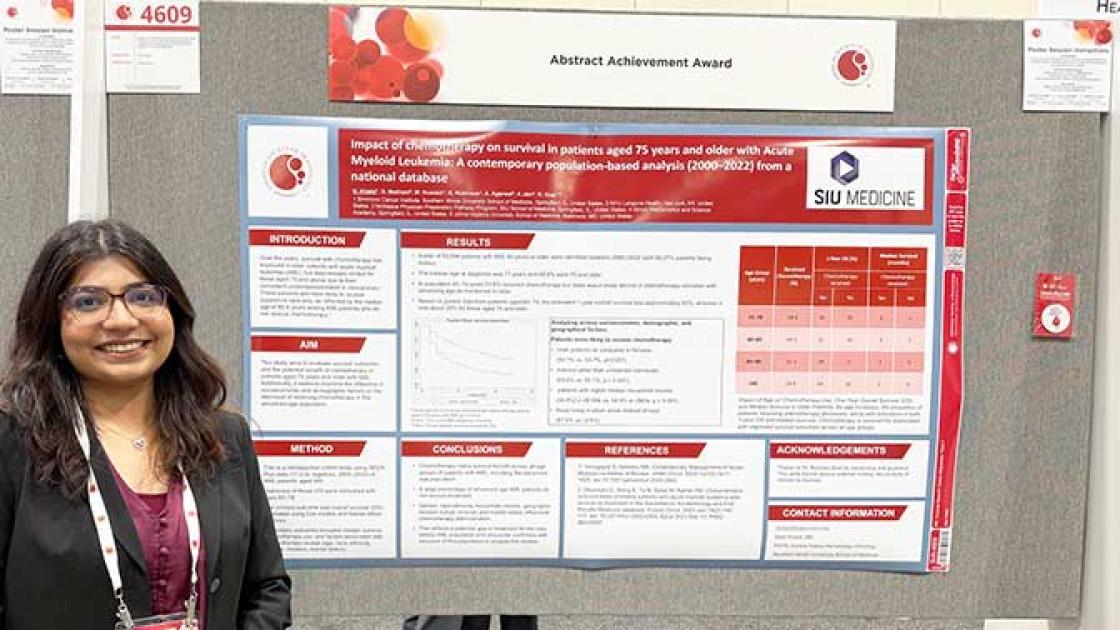
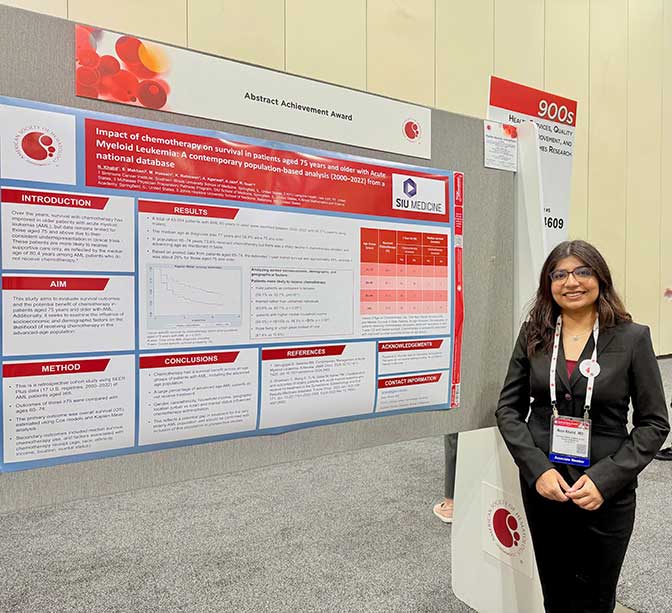
Khalid recently received a 2025 Abstract Achievement Award from the American Society of Hematology, which honors high-quality research by physician trainees selected through a competitive peer-review process for presentation at the society’s annual international meeting. She was mentored by Dr. Ruchika Goel at Simmons Cancer Institute.
Research shaped by real-world gaps
In her clinical work across central and southern Illinois, Khalid frequently cares for older adults with blood cancers who must weigh complex decisions with limited data tailored to their age group.
“Many of the treatment guidelines we rely on are based on younger, healthier patients,” Khalid said. “But the people I see every day are much older, often with other medical conditions. I wanted to know what the outcomes actually look like for them.”
Using more than 20 years of longitudinal national data, Khalid examined survival outcomes among older adults with blood cancers who did and did not receive chemotherapy.
What the study found
Khalid’s analysis showed that, on average, older adults who received chemotherapy lived longer than those who did not — including patients over age 80.
“That doesn’t mean treatment is right for everyone,” Khalid said. “But it does show that advanced age alone should not automatically exclude someone from being considered for therapy.”
The study also revealed that a substantial proportion of older adults never receive cancer treatment.
“Where someone lives, whether they have social support, transportation or access to specialized care — all of those factors can influence whether treatment even becomes an option,” Khalid said.
Rather than promoting a single “correct” choice, Khalid said the findings are meant to support more meaningful, individualized conversations.
“Our goal is to give patients and families clearer information so they can weigh benefits, risks and personal priorities together with their physician,” she said.
Team science with local impact
The project included collaborators from Simmons Cancer Institute (SCI), including Dr. Kathy Robinson, director of clinical trials at SCI, investigators from NYU Langone and student participants from SIU Medicine’s McNeese Physician Preparatory Pathway Program.
Ruchika Goel, OH Wesley Endowed Chair in Hematology, Associate Vice Chair of Research and professor of internal medicine and pediatrics at SIU Medicine, said Khalid led the project from start to finish.
“Dr. Khalid was deeply committed to this question because of what she was seeing in clinic,” Goel said. “She designed the study, wrote the proposal, performed the analysis and led the scientific writing. This level of ownership is exceptional, and we are incredibly proud of her! I hope she can apply her research to her clinical practice to improve patient outcomes.”
 Building a career at SIU Medicine
Khalid completed her internal medicine residency at SIU School of Medicine and chose to continue her fellowship training in Springfield, drawn by the opportunity to combine patient-centered research with hands-on clinical care.
“Being able to study questions that come directly from patient encounters — and then bring those answers back into the exam room — is what motivates me,” Khalid said.
Through nationally recognized research grounded in everyday patient conversations, Khalid’s work reflects SIU Medicine’s mission to improve health across central and southern Illinois through education, patient care, research and service.